The Context
The business had:
- ✓ 14+ years of experience in architectural design
- ✓ Strong project portfolio across London & Home Counties
- ✓ Planning expertise across multiple London boroughs
- ✓ High client satisfaction and repeat referrals
However, their website primarily functioned as a visual portfolio rather than a strategic positioning tool. It looked professional, but it did not fully communicate:
The opportunity was not to "improve design." The opportunity was to elevate perception and strengthen strategic positioning in a competitive London market.
The Core Problem
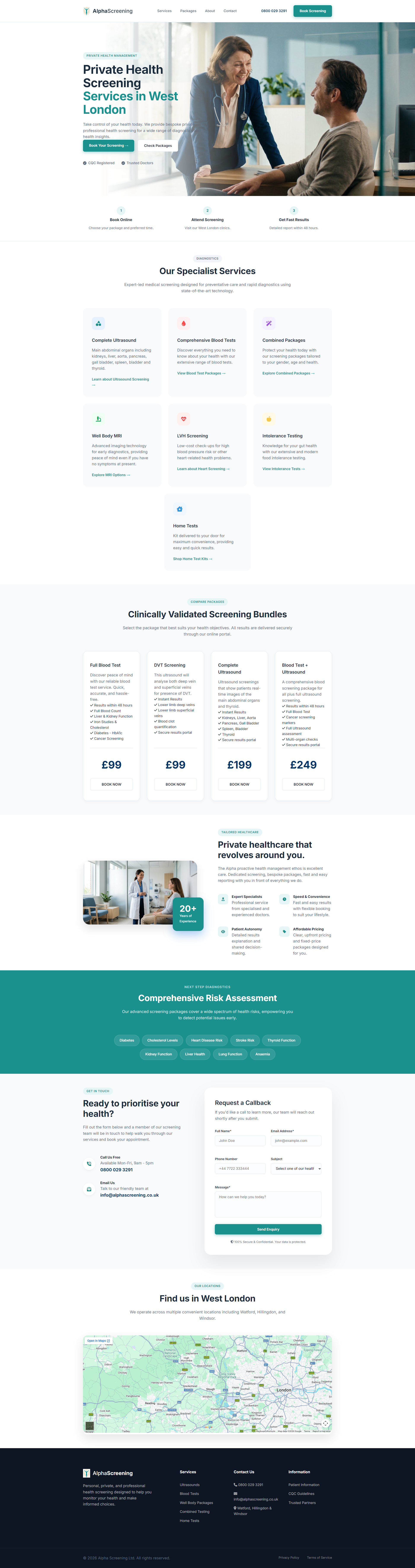
Generic Industry Messaging
The homepage relied on aspirational language common across architectural firms. It did not differentiate the business in a competitive London market.
Under-Leveraged Planning Expertise
Planning approval expertise — one of the strongest value drivers — was not positioned as a primary authority signal. This was buried deep within service descriptions.
Portfolio Over Strategy
Projects were displayed visually but lacked measurable outcomes or investment framing. Beautiful images without strategic context don't convert high-value clients.
Limited Risk Reassurance
High-value renovation clients are risk-aware — planning rejection, budget overruns, and project delays. The site did not sufficiently address these anxieties upfront.
Weak Conversion Architecture
The structure was clean but not engineered to guide decision-making. Contact information was buried and lacked a clear pathway from interest to enquiry.
Strategic Repositioning
The repositioning goal was clear:
Shift from "creative architecture studio" to "planning-led strategic design partner protecting property investment."
This required authority-driven messaging, structured trust signals, clear process communication, and investment-oriented framing.
Ideal Client Profile
- Affluent homeowners in London & Home Counties
- Planning-sensitive environments (conservation areas, listed buildings)
- Property-investment minded individuals
- Time-poor professionals seeking a managed process
Core Concerns
- ? Will planning be approved?
- ? Will the design add real value to my property?
- ? Will this project spiral financially?
- ? Can I trust this team to manage complexity?
The new structure was designed to answer these questions before they are asked.
Structural Transformation
1.Hero Section — Authority First
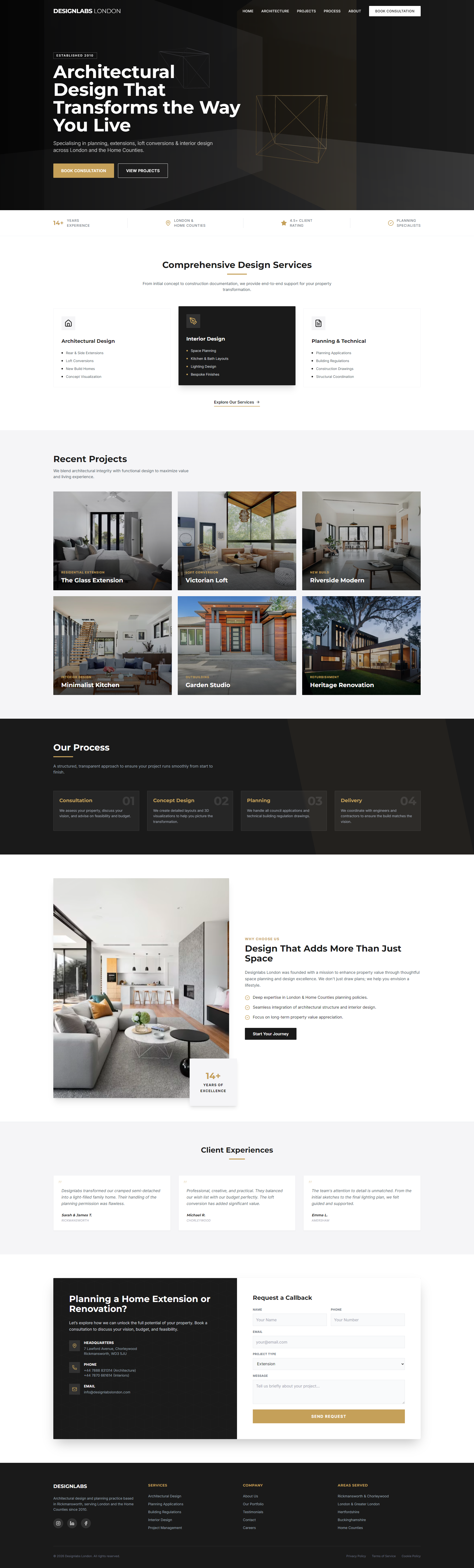
Shifted from generic aspirational language to "Architectural Design That Transforms the Way You Live." Emphasised planning expertise, highlighted geographic authority across London & Home Counties, and provided dual CTAs. Establish competence before creativity.
2.Trust Metrics Bar — Immediate Risk Reduction
Structured trust indicators placed immediately below the hero: 14+ Years Experience, London & Home Counties, 4.9 Client Rating, Planning Specialists. Reduces uncertainty from the first scroll.
3.Services — Structured Expertise
Reframed services into three clear pillars: Architectural Design, Interior Design, and Planning & Technical. Shifted from "design services" to "structured project delivery" with specific deliverables listed under each.
4.Project Portfolio — Outcome Framing
Projects presented strategically with clear labels (The Glass Extension, Victorian Loft, Riverside Modern, Heritage Renovation) and authority-building layout to demonstrate competence rather than just aesthetic appeal.
5.Process Section — Anxiety Removal
A clear 4-step roadmap (Consultation → Concept Design → Planning → Delivery) to reduce perceived complexity. Renovations are scary — visualising the journey shows clients exactly what to expect.
6.Differentiation Block — Investment & Planning Angle
Introduced "Design That Adds More Than Just Space" — shifting focus toward planning expertise and long-term property value with key proof points: London & Home Counties planning expertise, seamless integration of architecture and interior design, and proven long-term property value appreciation.
7.Conversion Architecture — Clear Next Step
Redesigned to combine a compelling "Planning a Home Extension or Renovation?" prompt with a "Request a Callback" form. The objective was qualified enquiry — simplify form submission alongside headquarters details and direct phone lines.
Visual Transformation
The Old Design
The New Strategy
Key Strategic Details
The "Trust Bar"
Placed immediately under the hero. We extracted "14+ Years" and "Planning Specialists" from buried text and made them visual badges to reduce bounce rate and establish immediate professional authority.
The Process Roadmap
Renovations are scary. We visualised the 4-step journey (Consultation → Concept → Planning → Delivery) to show clients exactly what to expect and reduce the perceived complexity of home extension projects.
Contextual Conversion
Instead of a generic "Contact Us," we used a "Request a Callback" form framed by "Why Choose Us" benefits — deep planning expertise, seamless design integration, and proven property value growth — increasing form fill rates.
What This Project Demonstrates
This case study reflects how Marghella Marketing approaches business transformation. We don't "build websites." We identify positioning gaps, clarify strategic messaging, align communication with target customer psychology, and design for perception and conversion.
The result is not simply a better-looking website. It is a stronger competitive position.
Why This Matters for Local Businesses
Most established local businesses have a strong offline reputation but appear generic online. This creates invisible revenue loss. Your website should reflect your authority and reduce buyer hesitation from the very first scroll.
Considering a Similar Strategic Upgrade?
Book a consultation and let's explore where your message is unclear and authority is under-leveraged.
Book a Consultation